

Choanoflagellates are the closest unicellular relatives of the animals (Metazoa).
They seem like very simple organisms. They have a flagellum and a collar, similarly to sponge choanocytes. They use these structures to capture bacteria. Some species have other external structures, such as basket-looking loricas and thecas.
Read more about choanoflagellates here and here.
Choanoflagellates are very common in freshwater and marine environments and they look very gentle and fragile. Yet they managed to survive for around 28-50 thousand years in one of the most extreme environments on Earth. Part of my research was about studying these amazing protists that we found in the Siberian permafrost.
Many groups of organisms are known to have this remarkable ability to stay viable for a long time. Some bacteria are found in permafrost samples that are as old as several million years. Some of them even stay metabolically active according to studies of some researchers. But most form resting stages.
The choanoflagellates that I was working with are not that old, but the fact itself is very interesting.
 | |
| A choanoflagellate (Codosiga botrytis) cell feeding on bacteria |
Surviving desiccation and freezing is totally normal for microorganisms. In a lot of environments they have to tolerate all these hostile conditions periodically. They can just ran away and settle in another body of water or dig themselves deeper into the ground to stay warmer.
However, thousands of years under extreme conditions with the temperature of -13 degrees Celsius, lack of free water, light, oxygen and food resembles being in space.
Do they have metabolic activity or not? How do they "see" if the environment is suitable for life and what triggers their excystment? Can they actually survive in space? Those are just few questions that arise when you deal with ancient fauna.
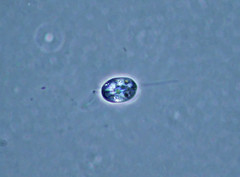 |
The ciliate on the left is dyed with acridine orange, match animation phase contrast-fluorescence. The animation requires flash. On the right one of the flagellates observed in permafrost - Anisonema ovale.
Codosiga botrytis is the most common choanoflagellates species observed. However, when it comes to identifying species in microorganisms, traditional approaches fail. The most common definition of species involves sex: if two organisms can give a viable offspring that can reproduce, they are considered to belong to the same species.But even when protists do have some sort of horizontal gene transfer, the classical approach does not always work. Two protists can be morphologically identical and yet phylogenetic analysis reveals differences. At the same time, molecular approaches can show identity of morphologically different cultures. Species problem overall is a very serious issue in protistology and microbiology. In my case all Codosiga culteres from permafrost and the same morphospeceis isolated from various regions around the world are not identical based on rRNA genes. Not only they have a lot of cryptic species, they also form a phylogenetic clade standing aside from other known choanoflagellates. This fact is making comparison of ancient and modern species very difficult.


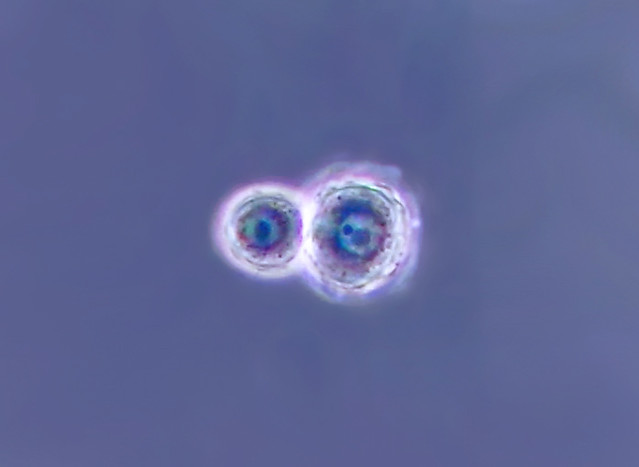
Two conjoined cysts visible through the microscope. 100x, phase contrast, noise reduction applied.
Just to make it clear, the choanoflagellates are normally 4-15 micrones in length. This is a small part of the work that I am about to publish. Currently we don't know anything about the mechanisms the protists use to survive thousands of years of cryoconservation. Protists are very tricky object to work with and we know so little about them. There are a lot of protists that even refuse to grow in cultures, making their study nearly impossible. Choanoflagellates are becoming a popular object to work with, mainly due to their relation to multicellular animals. For two species full genome has been already sequenced.
High resolution DIC images and animation created together with Aron Keve Kiss Added: Our article came out.

No comments:
Post a Comment